Explore our engineered selection of precision downlights, trimless recessed fixtures, and premium ambient luminaires manufactured to strict European CE, RoHS, and North American UL safety standards.
As the global architectural and commercial lighting industries evolve toward energy efficiency, human-centric design, and deep mechanical customization, international buyers—including wholesalers, lighting design agencies, project specifiers, and OEM brand owners—are increasingly seeking high-gain manufacturing partnerships. China remains the undisputed epicenter of global solid-state lighting production, producing over 70% of the world's recessed downlight fixtures and architectural luminaires.
However, selecting among thousands of suppliers across industrial hubs like Guzhen (Zhongshan), Ningbo, Foshan, and Shenzhen requires rigorous evaluation. Modern procurement is no longer merely about acquiring low-cost bill-of-materials (BOM); it demands partner capabilities spanning advanced thermal modeling, glare control optics (UGR < 19 / UGR < 13), CCT-switchable driver integration, and international certification matrices (including CE, RoHS, UL, ETL, and SAA).
This authoritative whitepaper provides global procurement executives and lighting specifiers with deep technical insights into OEM/ODM manufacturing standards, emerging product technology trajectories, procurement strategies, and quality assurance protocols for sourcing downlight fixtures from leading Chinese factories.
The commercial downlight sector has transitioned from simple luminaire replacement to sophisticated architectural light sculpture and intelligent environmental management. When auditing top China downlight manufacturers, specifiers must evaluate five critical technological vectors:
Architectural standards for offices, hotels, and luxury retail increasingly enforce Unified Glare Rating (UGR) thresholds below 19, with premium hospitality requiring UGR < 13. Leading factories utilize dual-reflector configurations, dark-light aluminum baffles, micro-prismatic lenses, and deep-set COB (Chip-on-Board) recessed geometry. This prevents direct visual contact with the light source at standard viewing angles, minimizing visual fatigue and elevating space aesthetics.
Standard Color Rendering Index (CRI Ra > 80) is no longer sufficient for high-end commercial specification. Premier Chinese manufacturers now integrate full-spectrum LED chips (such as Bridgelux, Citizen, and CREE) capable of delivering CRI 95–98 with R9 (red color rendition) values exceeding 90. Furthermore, evaluation according to IES TM-30-18 (Rf fidelity index and Rg gamut index) ensures true-to-life color fidelity essential for museum lighting, luxury apparel, and high-end residential interiors.
To mitigate inventory holding costs and supply chain complexity for distributors, modern downlight designs incorporate built-in CCT selection switches (allowing 2700K, 3000K, 3500K, 4000K, and 5000K in a single fixture) and multi-wattage selectable drivers. A single trimless downlight unit can replace up to 15 traditional SKUs, delivering massive efficiency gains in warehouse management and project fulfillment.
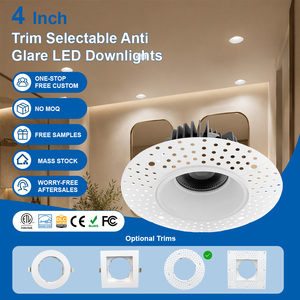
Minimalist interior design trends dictate ceiling-to-fixture continuity. Trimless (plaster-in) downlight frames allow smooth mudding into drywall ceilings, eliminating visible outer bezels. Top-tier factories utilize die-cast aluminum frames with anti-crack perimeter mesh, snap-in magnetic engine modules, and toolless driver access to streamline installation and long-term maintenance.
Use this comparative matrix to benchmark prospective Chinese factory samples against international commercial lighting requirements.
| Performance Metric | Standard Commercial Grade | Architectural / Premium Grade | Impact on Project & Procurement |
|---|---|---|---|
| Unified Glare Rating (UGR) | UGR < 22 to UGR < 25 | UGR < 13 to UGR < 19 | Direct compliance with WELL & LEED visual comfort standards. |
| Color Quality (CRI & TM-30) | Ra > 80 (R9 > 0) | Ra > 95 (R9 > 90, Rf > 93, Rg ≈ 100) | Vivid texture rendering in hospitality, retail, and residential spaces. |
| Thermal Management | Stamped sheet aluminum / plastic sink | Die-cast ADC12 aluminum / Cold-forged heatsink | Ensures L80B10 > 50,000-hour operational longevity. |
| Dimming Protocol Support | Triac / Phase cut only | DALI-2, 0-10V, Push-DIM, Casambi, Matter | Enables seamless smart building and BMS integration. |
| Optical System | Basic diffuser / plastic reflector | Faceted aluminum reflector + optical TIR lens | Precise beam cut-offs (15°, 24°, 36°, 60°) without light spill. |
| Ingress Protection | IP20 (Indoor dry locations) | IP44 / IP65 (Wet location / Bathroom rated) | Expands application scope to spa, shower, and outdoor soffits. |
As macro-economic factors, environmental regulations, and building automation protocols shift, procurement leaders must align with suppliers capable of navigating future industry demands. Sourcing executives should monitor four key macro trends:
Traditional static downlights are rapidly giving way to connected luminaires. Modern procurement bids increasingly mandate DALI-2 D4i certified drivers or embedded wireless controllers supporting Zigbee 3.0, Bluetooth SIG Mesh, and the unified Matter protocol. Top China downlight factories are embedding power-metering drivers and IoT sensors directly within junction boxes, turning luminaires into data-gathering nodes for smart building automation systems.
Driven by European Union Ecodesign Directives (SLR/ELR) and global corporate ESG requirements, leading Chinese lighting factories are adopting circular manufacturing principles. This includes utilizing 100% recycled die-cast aluminum alloys, eco-friendly powder coating lines, plastic-free biodegradable packaging, and modular designs that allow toolless driver and LED engine replacement, dramatically reducing life-cycle carbon footprints.
Traditional product development cycles of 6–9 months are no longer acceptable for competitive lighting brands. Forward-thinking Chinese factories utilize 3D optical simulation software (TracePro/Zemax), 5-axis CNC prototyping, and modular tooling systems. This enables specifiers to receive custom-finished sample downlights, tailored beam angles, or custom flange configurations in as little as 10 to 14 working days.
B2B buyers now require comprehensive digital documentation prior to issuing purchase orders. Premier Chinese manufacturers maintain in-house darkrooms equipped with Goniophotometers and Integrating Spheres, providing downloadable IES and LDT photometric distribution files, REVIT/BIM 3D models, thermal dissipation test reports, and formal CE/RoHS/UL declarations of conformity for immediate integration into architectural specifications.
Rooted in a rich heritage of precision lighting engineering and vertical integration, our manufacturing operations deliver world-class OEM and ODM support tailored to international distributors, project contractors, and lighting design studios. When partnering with our facility, clients gain distinct competitive advantages:
From raw aluminum ingot die-casting and precision CNC machining to automated SMT LED chip placement, powder spraying, and final burn-in testing—100% of critical manufacturing processes occur within our audited facilities in China.
Equipped with Type-C Goniophotometers, spectroradiometers, surge testing apparatus, high-temperature aging chambers, and IP6X dust/water testing rigs to ensure rigorous compliance with international standards.
We modify mechanical dimensions, custom RAL color lacquering, optical reflector finishes (specular, matte, champagne gold, dark-light black), custom cable harnesses, and private labeling with low minimum order quantities (MOQs).
Our multilingual technical export team assists with full compliance documentation, customs clearing certificates (CE, RoHS, CB, SAA, UL/ETL), customs tariff guidance, and door-to-door global logistics management.
To ensure high quality, reliable delivery, and long-term brand integrity, international buyers must conduct thorough due diligence before selecting a manufacturing partner. Follow this essential 5-step auditing framework:
Inspect the weight and alloy grade of the heat sink. High-efficiency downlights require A380 or ADC12 die-cast aluminum with engineered cooling fins to maintain junction temperatures (Tj) below 85°C at ambient operating conditions. Avoid lightweight stamped sheet metal or plastic-clad heatsinks for commercial specifications.
The driver is the primary failure point in LED downlight installations. Confirm whether the factory partners with tier-1 driver manufacturers (e.g., Lifud, Tridonic, Philips Xitanium, MeanWell, or EAGLERISE) or uses high-grade internal isolated drivers featuring electrolytic capacitors rated for 105°C and 50,000+ hours. Demand ripple-free output (< 3% flicker index) adhering to IEEE 1789 health standards.
Request accredited third-party or in-house goniophotometer reports. Verify lumen output per watt (efficacy exceeding 100–120 lm/W for complete fixtures), light distribution curves, visual beam angles, and color consistency (MacAdam Ellipse ≤ 3 SDCM across production batches).
Ensure the factory enforces a 100% 4-to-24-hour high-voltage aging test process prior to packaging. Verify Incoming Quality Control (IQC) for LED chips, Input Process Quality Control (IPQC) during assembly, and Final Quality Assurance (FQA) random sampling standards (AQL 1.0 Major / 2.5 Minor).
Validate certificate numbers directly with issuing bodies (SGS, TÜV, Intertek, UL). Ensure that drivers, connectors, wiring, and housing materials bear valid CE, RoHS, UL, or SAA marks with traceable factory identification codes.
Get clear, expert answers to common questions regarding sourcing downlights, custom OEM tooling, quality assurance, and international logistics.
For standard catalogue downlights with custom finishes (e.g., specific RAL colors), MOQs typically start at 100–300 units per model. For completely custom OEM tooling or specialized optical lens design, initial production runs start at 500–1,000 units, depending on frame size and complexity.
Yes. Our in-house goniophotometric laboratory generates certified .IES and .LDT photometric files for all standard and customized downlight fixtures, enabling lighting designers and architects to perform accurate Lux and light layout simulations in DIALux or Relux software.
We source LED chips strictly within 3-step MacAdam Ellipse (3 SDCM) binning thresholds directly from premium chip manufacturers (Bridgelux, CREE, Citizen). This guarantees that downlights installed across expansive hotel corridors or office floors exhibit perfect color uniformity without visible color shifting.
Our downlight systems can be paired with drivers supporting Phase/Triac dimming, 0-10V/1-10V analog dimming, DALI-2 (Digital Addressable Lighting Interface), Push-DIM, and wireless smart ecosystems (Casambi, Tuya Zigbee, Matter).
Standard product samples ship within 3 to 5 working days. Modified custom samples take 10 to 14 days. Full container load (FCL) or bulk production orders are typically fulfilled and delivered to port within 25 to 35 calendar days following drawing approval.
Yes. We manufacture engineered IP65 waterproof downlights featuring silicone gasket seals, toughened glass lenses, corrosion-resistant powder coatings, and sealed cable glands specifically built for high-humidity and outdoor ceiling applications.
Elevate your commercial lighting portfolio with engineered precision, deep glare control, and factory-direct OEM/ODM support. Speak directly with our senior technical lighting specialists today.
Contact Us